02Thinking

The ideas behind the work.

The Thinking section is not another set of case studies. It is where the portfolio demonstrates judgement, point of view and the ability to articulate what has been learned from years of practice.

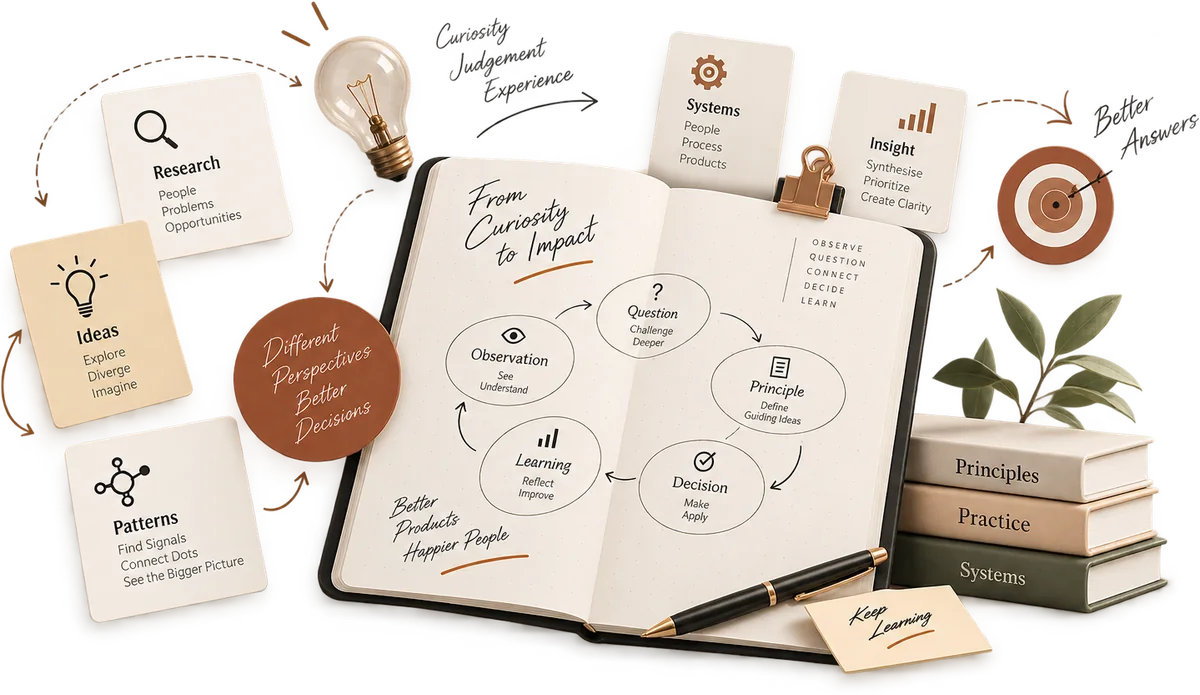
From curiosity to impact: a notebook cycle of observation, question, principle, decision and learning, surrounded by cards for research, ideas, patterns, systems and insight
01

Designing for complexity

Complex products don't necessarily need to become simpler.

Immigration, HR and compliance workflows contain rules, dependencies, deadlines and exceptions that cannot simply be removed.

The designer's job is to organise that complexity so it becomes progressive, contextual, visible and actionable.

"Don't simplify the system by hiding complexity. Simplify the experience by giving users the right complexity at the right moment."

02

When the real product is the system

Forms Designer taught me that the most valuable product may not be the interface users see.

If a business repeatedly creates the same type of thing, the opportunity may be to change who creates it and how the system enables them to create it.

Instead of asking engineering to repeatedly build forms, the product created a configuration layer using reusable components and technically connected mappings.

"Sometimes the best product is the capability that allows the organisation to keep creating."

03

AI should assist the expert

My interest in AI is practical: where can technology remove repetitive work and help people focus on what requires human judgement?

In document-heavy professional workflows, AI can help extract information, create a starting point or reduce repetitive writing. But the expert should remain responsible for reviewing and deciding what enters the final outcome.

"AI is most useful when it disappears into the workflow and simply helps people move forward."

04

Design for exceptions

Enterprise UX is often defined by what happens when the happy path breaks.

Missing information, incorrect data, missing signatures, failed validation, expired documents and compliance issues should not be treated as isolated error states. They should be designed as intentional paths with a clear route forward.

Issue detected
Reason identified
Correction
Re-validation
05

From screen design to system design

As products and teams grow, the designer's responsibility changes.

The work moves from designing individual screens toward understanding relationships between users, information, workflows, systems, business goals and organisational capability.

That is the level at which I increasingly operate.

06

What design leadership means

Leadership is not about having all the answers.

It is about helping people ask better questions, make stronger decisions and become more capable designers.

"I believe design leadership is not about having all the answers. It's about helping people learn how to ask better questions."